Elementary School at St. Mark Catholic School
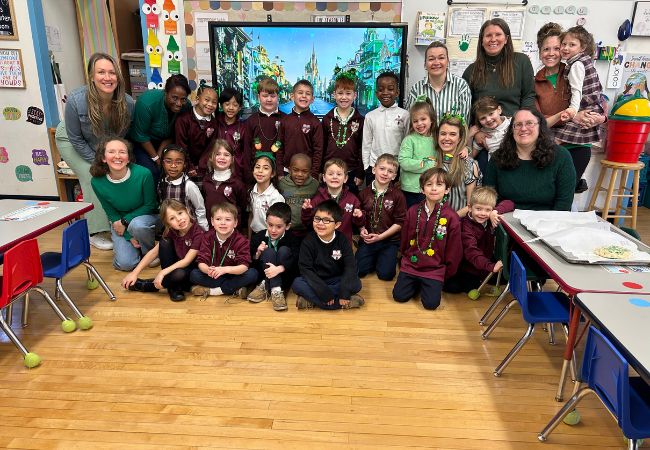
St. Mark School teaches grades one through five in Catonsville, on a campus that has educated children in this community since 1889. These are the years a child stops learning to read and starts reading to learn, and the years the gaps between children in the same classroom get wide. One second grader is three chapters into a novel. Another is still sounding out the title. Both belong here.
That is not a slogan. St. Mark runs two distinct programs to make it true. The Siena Program serves academically talented students with compacted curriculum, tiered instruction, independent projects, and acceleration. The Whatley Program serves students with learning differences through specialized language arts and math instruction, while those students stay with their grade level classmates for the rest of the day. A family does not have to guess which kind of child they have before enrolling, and does not have to move a child who turns out to be either.
Elementary School By The Numbers
Teacher to Student Ratio
Years of Academic Excellence
Zip Codes Represented
What Your Child Will Learn
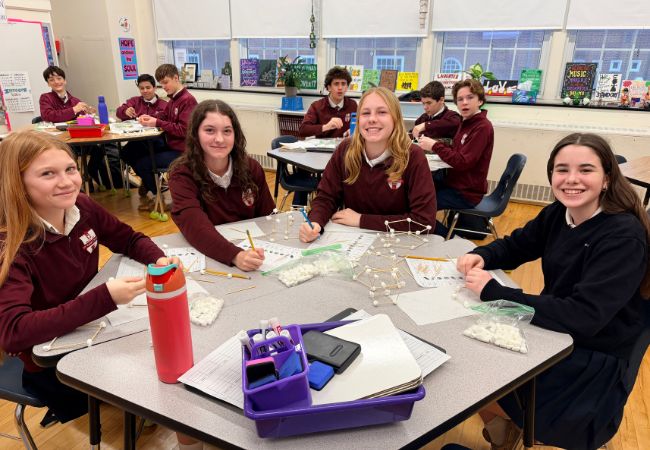
Elementary at St. Mark follows Archdiocese of Baltimore standards in religion, mathematics, and English language arts, with instruction in science, social studies, technology, art, music, library, Spanish, and physical education. Grade by grade the work gets harder in a way children can feel. First graders write opinion pieces. Third graders learn cursive and start comparing historical fiction across cultures. Fifth graders write arguments with evidence and run short research projects with multiple sources.
Alongside the academics, second grade is the year students prepare for First Reconciliation and First Communion, with that preparation happening inside the school day rather than on a weeknight somewhere else. Fifth and sixth graders can join Lego Robotics, and students compete in the Archdiocesan Spelling Bee. Open the toggles below for the full standards by grade.
Religion
“Bringing Good News” is the Archdiocese of Baltimore Religion Curriculum for Elementary Schools. This standards-based curriculum serves as a guide, a road map for both teachers and students as they embark on a journey, which will provide them with the knowledge and understanding of the faith as witnessed in the teachings and the traditions of the Catholic Church. The curriculum is built on the Six Tasks of Catechesis: Promoting Knowledge of the Faith; Liturgical Education; Moral Formation; Teaching to Pray; Education for Community Life; and Missionary Initiation and is aligned with the Assessment of Catholic Religious Education (IFG:ACRE).
By the completion of first grade, students will master a variety of skills including:
- Define the meaning of faith as a gift from God that enables us to know God and follow him.
- State that the Old Testament tells of God’s people before the birth of Jesus.
- State that the New Testament contains the Gospels, the Good News of Jesus.
- Identify sacraments as signs of God’s love for us.
- Recognize Jesus’ presence with us in the bread and wine that become his body and blood.
- State that God gives us the ability and the freedom to choose right or wrong.
- Understand that we are called in a special way to care for the poor and the suffering.
By the completion of second grade, students will master a variety of skills including:
- Recognize that there are three Persons in one God: the Father, Son and Holy Spirit that make up the Holy Trinity.
- Show an understanding of the Resurrection, that God raised Jesus from the dead.
- Identify and define the seven sacraments as signs of God’s love and the means to strengthen our relationship with God.
- Understand the Real Presence of the Risen Jesus in the Eucharist under the form of bread and wine.
- Express that we are given the gifts of free will and that our choices affect the lives of others.
- Explain that God created us to know, love and serve Him.
By the completion of third grade, students will master a variety of skills including:
- Recognize the Commandments as rules God gave us because he loves us.
- Explain that people are called to forgive others and work toward understanding.
- Explain the major seasons of the liturgical (Church) year.
- Recognize conscience as a guide to distinguishing good and evil.
- Identify Mary as an intercessor for us with God.
- Articulate that all people are called to holiness by living their lives close to God.
By the completion of fourth grade, students will master a variety of skills including:
- Describe the Holy Spirit as proceeding from both the Father and Son as perfect love and wisdom.
- Define sin as choosing to turn away from God and examine sin’s effect on our lives.
- Recognize the Mysteries of the Rosary are meditations on different events in the life of Christ and his Blessed Mother.
- Compose prayer from each of these categories: blessing and adoration, contrition, petition, intercession, thanksgiving and praise.
- Identify the Corporal and Spiritual Works of Mercy.
By the completion of the fifth grade, students will master a variety of skills including:
- Understand that the Church teaches that Jesus Christ is truly God and truly man.
- Identify and describe the major liturgical feasts and seasons of the Church year.
- Identify all human life as sacred and precious to God, made in God’s image and likeness.
- Understand that faithfulness to prayer and worship helps us to lead a moral life.
- Identify that the Church teaches that we must work for a more just and fair society and world.
Mathematics
The curriculum for all elementary schools in the Archdiocese of Baltimore include the following units:
- Counting and Cardinality
- Operations and Algebraic Thinking
- Measurement and Data
- Numbers and Operations in Base Ten
- Geometry
- Numbers and Operations
Catholic educators never forget that our schools exist to bring our students to Christ. By continuing to implement new standards that are challenging, we work to fulfill the promise of quality Catholic education that educates the whole child, both mind and soul.
By the completion of first grade, students will master a variety of skills including:
- Understand and apply properties of operations and the relationship between addition and subtraction.
- Use place value understanding and properties of operations to add and subtract.
- Measure lengths indirectly and by iterating length units.
- Tell and write time.
By the completion of second grade, students will master a variety of skills including:
- Represent and solve problems involving addition and subtraction.
- Work with equal groups of objects to gain foundations for multiplication.
- Relate addition and subtraction to length.
- Work with time and money.
- Represent and interpret data.
By the completion of third grade, students will master a variety of skills including:
- Understand properties of multiplication and the relationship between multiplication and division.
- Use place value understanding and properties of operations to perform multi-digit arithmetic.
- Develop understanding of fractions as numbers.
- Geometric measurement: understand concepts of area and relate area to multiplication and to addition.
By the completion of fourth grade, students will master a variety of skills including:
- Use the four operations with whole numbers to solve problems.
- Gain familiarity with factors and multiples.
- Generate and analyze patterns.
- Understand decimal notation for fractions, and compare decimal fractions.
- Draw and identify lines and angles, and classify shapes by properties of their lines and angles.
By the completion of fifth grade, students will master a variety of skills including:
- Write and interpret numerical expressions.
- Perform operations with multi-digit whole numbers and with decimals to hundredths.
- Convert like measurement units within a given measurement system.
- Geometric measurement: understand concepts of volume and relate volume to multiplication and to addition.
- Graph points on the coordinate plane to solve real-world and mathematical problems.
- Classify two-dimensional figures into categories based on their properties.
English Language Arts
The English Language Arts Curriculum for the Archdiocese of Baltimore is designed using the Catholic, College and Career Ready clusters as its foundation. Through literature, this course of study fosters students’ Catholic identity, shaping them to be models of Christian living for others. This curriculum is fully integrated with our Catholic faith. We provide students with a curriculum that is rigorous and rich in literature, oral and written language, grammar, writing, vocabulary, informational literature, and multimedia/technology.
By the completion of first grade, students will master a variety of skills including:
- Use reading strategies to determine central themes, develop understanding, identify and utilize various text features, determine key ideas and describe connections.
- Become proficient readers with the capacity to comprehend texts across a range of types and disciplines.
- Identify basic features of print such as the alphabetic principle, phonological awareness, phonics, decoding, and blending.
- Write opinion pieces, informative/explanatory texts, narratives and should participate in shared research and writing.
- Participate in collaborative discussions; communicate effectively using a variety of tools demonstrate efficient relay of information; and produce complete sentences appropriate to the task and situation.
By the completion of second grade, students will master a variety of skills including:
- Use an inquiry process to locate, evaluate and use sources based on accuracy, authority, and point of view to explore a question/topic and synthesize and share findings and give appropriate credit/ citation.
- Select and use appropriate format to effectively engage the target audience in a topic, point of view, argument and/or creative work.
- Analyze and evaluate information, ideas, or objects to develop a point of view, make predictions, or draw inferences
- Identify and define a problem-situation and work through a procedure to determine viable and appropriate solutions and next steps and carryout as applicable.
- Generate and develop ideas, solutions and connections to create something original/ novel that is meaningful or useful.
By the completion of third grade, students will master a variety of skills including:
- Students will use text presented orally and visually to engage in collaborative discussions with peers.
- Students will learn to write in cursive, and will learn and apply spelling patterns and standard English language conventions.
- Using vowel digraphs and diphthongs.
- Compare and contrast historical fiction from various cultures.
- Understand the use of dialect within literature.
By the completion of fourth grade, students will master a variety of skills including:
- Through reading a diverse array of literature and informational text, students are expected to analyze the structure of the text, compare and contrast, and refer to the evidence in the text, to interpret, integrate, explain, and describe their reading perspective.
- Students should show an ability to write informative, opinion and narrative pieces with clear and coherent writing. Using the writing process, students will develop and strengthen their writing skills.
- Research skills should be practiced over an extended period of time, using evidence from various text to support, analyze and reflect the research.
- Students should participate in a range of class discussions, posing specific questions, paraphrasing text and giving support for their opinions.
- Instruction should focus on correct punctuation, capitalization, multi-meaning words, and figurative language.
By the completion of fifth grade, students will master a variety of skills including:
- Demonstrate a command of the conventions of standard English grammar and usage when writing or speaking.
- Summarize a written text read aloud or from information presented in a variety of media and formats, including visual, quantitative, and oral.
- Determine a theme of a story, drama, or poem from details in the text, including how characters in the story or drama respond to challenges or how the speaker in a poem reflects upon a topic and be able to summarize the text.
- Write arguments to support claims in analysis of substantive topics or texts using valid reasoning and relevant and sufficient evidence.
- Conduct short research projects that use several sources to build knowledge through investigation; additionally, produce more substantial research projects demonstrating understanding of the subject.
Additional Subject Areas
The following subject areas are currently under revision across the Archdiocese of Baltimore, and if you would like more information regarding these standards and essential skills please contact the school directly.
- Science
- Instructional Technology
- Social Studies
- Visual and Performing Arts
- Physical Education/Health
- World Languages
“Teachers are wonderful and take care of all of the students needs. I feel that they are very prepared with a rigorous program. Super sense of community between the faculty, staff, and HASA association.”
– St. Mark Parent
Why Parents Choose St. Mark for Elementary School

The Siena Program
Preparation for the Sacraments
STEAM Curriculum
Robotics
One Campus, One Community
Teachers Who Were Students Here
Schedule Your Private Tour
Seats remain in several elementary grades for the coming school year. The most useful thing you can do is walk the hallway during a normal school day and watch a class that is not expecting you. Tours run through the year and are led by our student ambassadors. Call the school office at 443-860-0926 or send an inquiry and we will find a time.
Explore St. Mark School By Grade Level
Preschool
Kindergarten