Middle School at St. Mark
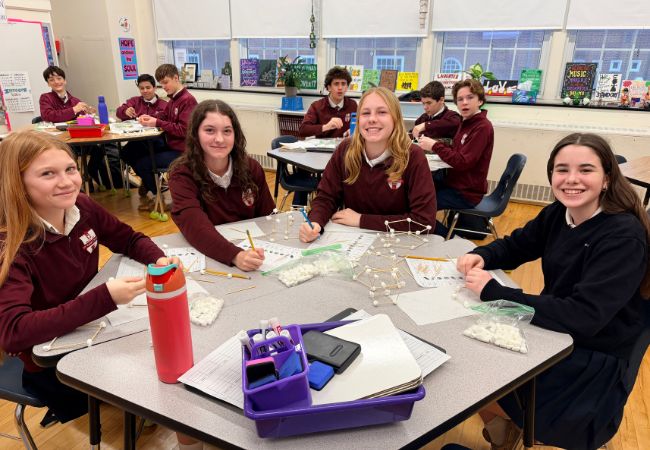
Middle school is where most families in this area make a change, and where the families already at St. Mark decide whether to stay. Grades six through eight here are departmentalized. Students change rooms, change teachers, and answer to a different subject specialist every period, which is exactly the structure they will meet in ninth grade. The point is not to make thirteen year olds miserable early. It is that a student who has already learned to carry four teachers expectations at once does not spend freshman year learning it.
The academics accelerate through these years in math, laboratory science, and English. Advanced eighth graders take a full Algebra course, which means arriving at high school with that year already behind them. Alongside it students learn the unglamorous things nobody puts on a banner: how to take notes, how to plan backward from a due date, how to ask a teacher for help before it is a crisis.
Middle School By The Numbers
Average Class Size
High Schools Our Graduates Attend
Zip Codes Represented
Where Our Graduates Go
Eighth grade at St. Mark ends with a high school acceptance letter, and usually with a choice between several. Our Class of 2026 is heading to selective Catholic high schools and to competitive entry public magnet programs across Baltimore City, Baltimore County, and Howard County. The list below is that class, not a historical best of.

What Your Child Will Learn
Middle school at St. Mark follows Archdiocese of Baltimore standards, taught by subject specialists in a departmentalized schedule. Sixth grade math moves into ratios and statistical variability. Seventh grade takes on proportional relationships and probability. Eighth grade reaches irrational numbers, functions, and the Pythagorean Theorem, and advanced students go further into a full Algebra course covering linear and exponential relationships, descriptive statistics, and quadratics.
Religion follows the same arc from the history of the Chosen People in sixth grade through moral decision making and the ecumenical councils in eighth. Science is taught with laboratory courses. Technology is integrated through project based work rather than taught as a separate skill in isolation. Open the toggles below for the standards by grade.
Religion
“Bringing Good News” is the Archdiocese of Baltimore Religion Curriculum for Elementary Schools. This standards-based curriculum serves as a guide, a road map for both teachers and students as they embark on a journey, which will provide them with the knowledge and understanding of the faith as witnessed in the teachings and the traditions of the Catholic Church. The curriculum is built on the Six Tasks of Catechesis: Promoting Knowledge of the Faith; Liturgical Education; Moral Formation; Teaching to Pray; Education for Community Life; and Missionary Initiation and is aligned with the Assessment of Catholic Religious Education (IFG:ACRE).
By the completion of sixth grade:
- Explain that at the end of time, Christ will return and we will be held accountable for how we responded to the gift of faith and helped to build the Kingdom of God.
- Trace the unfolding of God’s revelation through the history of the Chosen People ‐ the Jews.
- Describe each of the seven sacraments as entrusted to the Church.
- Indicate how the Decalogue relates to current moral issues and leads to greater understanding of the Gospel through the Great Commandment.
- Discuss evangelization as central to the mission of the Church in which we all have a role.
By the completion of seventh grade:
- Recognize that the Bible has both divine and human authorship initiated by God to reveal the truths God intends.
- Investigate the fruits of the Sacrament of Baptism to include forgiveness of all sins, birth into a new life, and a share in Christ’s three‐fold mission as priest, prophet, and king.
- Explain how a well‐formed conscience is developed through the knowledge of Scripture and Church doctrine as well as the witness of Church leaders and faithful role models, past and present.
- Explain the importance of Christians taking an active part in public life and promoting the common good.
- Discuss the call to religious life in the Church which is identified in two forms: active and contemplative.
By the completion of eighth grade:
- Understand that Jesus’ paschal mystery, that is his life, passion, death, resurrection and ascension, are central to Jesus’ mission on earth and the fulfillment of revelation.
- Explain that the context of moral decision‐making within the Catholic Christian tradition reflects the values of human dignity, God’s grace, the virtues, the Holy Spirit, and the teaching of the church.
- Understand that our beliefs are sound and rooted in Apostolic Tradition and Sacred Scripture, as entrusted to the teaching office (Magisterium) of the Church.
- Describe the progress and continuation of the Church’s mission through ecumenical councils, including, but not limited to: the Councils of Nicaea and Chalcedon, Vatican I, Vatican II, Fourth Lateran, Trent, Constantinople, and Ephesus.
- Communicate that our respect of other Christians means that we can both recognize what we share in common but that we also need to be honest about how we differ.
Mathematics
Revised in 2013, the curriculum for all elementary schools in the Archdiocese of Baltimore include the following units:
- Counting and Cardinality
- Operations and Algebraic Thinking
- Measurement and Data
- Numbers and Operations in Base Ten
- Geometry
- Numbers and Operations
Catholic educators never forget that our schools exist to bring our students to Christ. By continuing to implement new standards that are challenging, we work to fulfill the promise of quality Catholic education that educates the whole child, both mind and soul.
By the completion of sixth grade:
- Understand ratio concepts and use ratio reasoning to solve problems.
- Reason about and solve one-variable equations and inequalities.
- Represent and analyze quantitative relationships between dependent and independent variables.
- Solve real-world and mathematical problems involving area, surface area, and volume.
- Develop understanding of statistical variability.
By the completion of seventh grade:
- Analyze proportional relationships and use them to solve real-world and mathematical problems.
- Use properties of operations to generate equivalent expressions.
- Solve real-life and mathematical problems using numerical and algebraic expressions and equations.
- Draw, construct and describe geometrical figures and describe the relationships between them.
- Use random sampling to draw inferences about a population.
- Investigate chance processes and develop, use, and evaluate probability models.
By the completion of eighth grade:
- Know that there are numbers that are not rational, and approximate them by rational numbers.
- Work with radicals and integer exponents.
- Understand the connections between proportional relationships, lines, and linear equations.
- Define, evaluate, and compare functions.
- Understand congruence and similarity using physical models, transparencies, or geometry software.
- Understand and apply the Pythagorean Theorem.
In addition, advanced eighth grade students are offered a higher level course in Algebra. That course of study includes the following units:
- Relationships Between Quantities and Reasoning with Equations
- Linear and Exponential Relationships
- Descriptive Statistics
- Expressions and Equations
- Quadratics Functions and Modeling
English Language Arts
Revised in 2014, the English Language Arts Curriculum for the Archdiocese of Baltimore is designed using the Catholic, College and Career Ready clusters as its foundation. Through literature, this course of study fosters students’ Catholic identity, shaping them to be models of Christian living for others. This curriculum is fully integrated with our Catholic faith. We provide students with a curriculum that is rigorous and rich in literature, oral and written language, grammar, writing, vocabulary, informational literature, and multimedia/technology.
By the completion of sixth grade:
- Explain that at the end of time, Christ will return and we will be held accountable for how we responded to the gift of faith and helped to build the Kingdom of God.
- Trace the unfolding of God’s revelation through the history of the Chosen People ‐ the Jews.
- Describe each of the seven sacraments as entrusted to the Church.
- Indicate how the Decalogue relates to current moral issues and leads to greater understanding of the Gospel through the Great Commandment.
- Discuss evangelization as central to the mission of the Church in which we all have a role.
By the completion of seventh grade:
- Recognize that the Bible has both divine and human authorship initiated by God to reveal the truths God intends.
- Investigate the fruits of the Sacrament of Baptism to include forgiveness of all sins, birth into a new life, and a share in Christ’s three‐fold mission as priest, prophet, and king.
- Explain how a well‐formed conscience is developed through the knowledge of Scripture and Church doctrine as well as the witness of Church leaders and faithful role models, past and present.
- Explain the importance of Christians taking an active part in public life and promoting the common good.
- Discuss the call to religious life in the Church which is identified in two forms: active and contemplative.
By the completion of eighth grade:
- Understand that Jesus’ paschal mystery, that is his life, passion, death, resurrection and ascension, are central to Jesus’ mission on earth and the fulfillment of revelation.
- Explain that the context of moral decision‐making within the Catholic Christian tradition reflects the values of human dignity, God’s grace, the virtues, the Holy Spirit, and the teaching of the church.
- Understand that our beliefs are sound and rooted in Apostolic Tradition and Sacred Scripture, as entrusted to the teaching office (Magisterium) of the Church.
- Describe the progress and continuation of the Church’s mission through ecumenical councils, including, but not limited to: the Councils of Nicaea and Chalcedon, Vatican I, Vatican II, Fourth Lateran, Trent, Constantinople, and Ephesus.
- Communicate that our respect of other Christians means that we can both recognize what we share in common but that we also need to be honest about how we differ.
Additional Subject Areas
The following subject areas are currently under revision across the Archdiocese of Baltimore, and if you would like more information regarding these standards and essential skills please contact the school directly.
- Science
- Instructional Technology
- Social Studies
- Visual and Performing Arts
- Physical Education/Health
- World Languages
“This is an amazing community school with teachers who ask about the students long after they have gone on to the next grade or graduated. As a faculty member, you couldn’t ask for a more caring community to work in. I am constantly impressed with the new teachers and their commintment to quality education, and their flexibility and willingness to work to the best interests of each child. The current principal is caring, professional, and dedicated to making this school the best it can be.”
– St. Mark Parent
Why Parents Choose St. Mark for Middle School

Small Group Differentiated Instruction
Preparation for the Sacraments
STEAM Curriculum
Robotics
One Campus, One Community
Teachers Who Were Students Here
Schedule Your Private Tour
Seventh grade has limited seats for the coming school year. A middle school tour is different from a preschool tour, and worth doing with your child rather than without them: they will tell you inside five minutes whether they can picture themselves in that hallway. Tours run during the school day and are led by our student ambassadors. Call the school office at 443-860-0926 or send an inquiry.
Explore St. Mark School By Grade Level
Preschool
Kindergarten